AI Tools for Summarizing Textbooks: 17 Best Tools for PDFs, Notes & Flashcards
Textbooks are full of valuable information, but they are also long, dense, and time-consuming to study.
AI tools for summarizing textbooks help students convert long textbook chapters and PDFs into summaries, notes, flashcards, and study guides for faster learning.
A single chapter can take hours to read properly, especially when it includes formulas, definitions, case studies, and research-heavy explanations. For students trying to revise faster, prepare for exams, or turn a long PDF into usable notes, that is a major problem.
The best AI tools for summarizing textbooks can turn long PDF chapters into summaries, study notes, flashcards, quizzes, and simpler explanations. They are especially useful for students who need faster revision and better exam preparation.
This is why AI tools for summarizing textbooks are getting so much attention. Instead of manually extracting notes from every page, you can use AI to condense textbook chapters, ask questions about difficult topics, and build a faster study workflow around the material.
Imagine uploading a 40-page textbook chapter and getting a study guide, key definitions, revision questions, and flashcards in minutes. That is the real appeal of these tools.
In this guide, you’ll find the best AI tools for summarizing textbooks, a quick comparison table, use-case recommendations, free vs paid options, prompt ideas, and a practical workflow for turning textbooks into notes and flashcards faster.
You can also explore our guide on AI tools for making study notes to organize summaries into structured notes for better studying.
Quick Answer: Best AI Tools for Summarizing Textbooks
If you want the short version, these are the strongest options for most students:
- NotebookLM – best overall for deep study, grounded summaries, and multi-source learning
- Mindgrasp AI – best for students who want summaries, notes, quizzes, and flashcards in one place
- Knowt AI – best for turning PDFs into flashcards, quizzes, and exam practice
- SciSpace – best for research-heavy textbooks and academic PDFs
- Scholarcy – best for chapter breakdowns, key claims, and flashcard-style academic summaries
What Are AI Tools for Summarizing Textbooks and PDFs?
AI tools for summarizing textbooks are AI-powered study tools that turn long textbook chapters, PDFs, and academic documents into shorter summaries, notes, flashcards, quizzes, and study guides. They help students review faster, understand key concepts, and prepare for exams more efficiently.
Instead of reading a long chapter line by line just to extract the core ideas, these tools scan the content and identify:
- key concepts
- important definitions
- main arguments
- chapter takeaways
- exam-relevant points
- questions you should revise
Some tools are better for quick summaries. Others are better for flashcards, PDF Q&A, or research-style reading. That difference matters when choosing the right tool.
Why Students Use AI Tools to Summarize Textbooks Faster
Students usually do not just want a shorter chapter. They want a faster way to understand what matters, revise key ideas, and remember them later.
That is why AI study tools are useful. They can reduce the first-pass reading load and help students focus on the most important material first.
- summarize textbook chapters with AI
- turn PDFs into notes
- create flashcards for active recall
- generate quiz questions
- simplify difficult explanations
- support faster exam revision
If you are dealing with theory-heavy subjects like law, philosophy, or business, a clean summary can save time. If you are studying biology or medicine, a tool that supports deeper Q&A may be more useful than a basic summarizer.
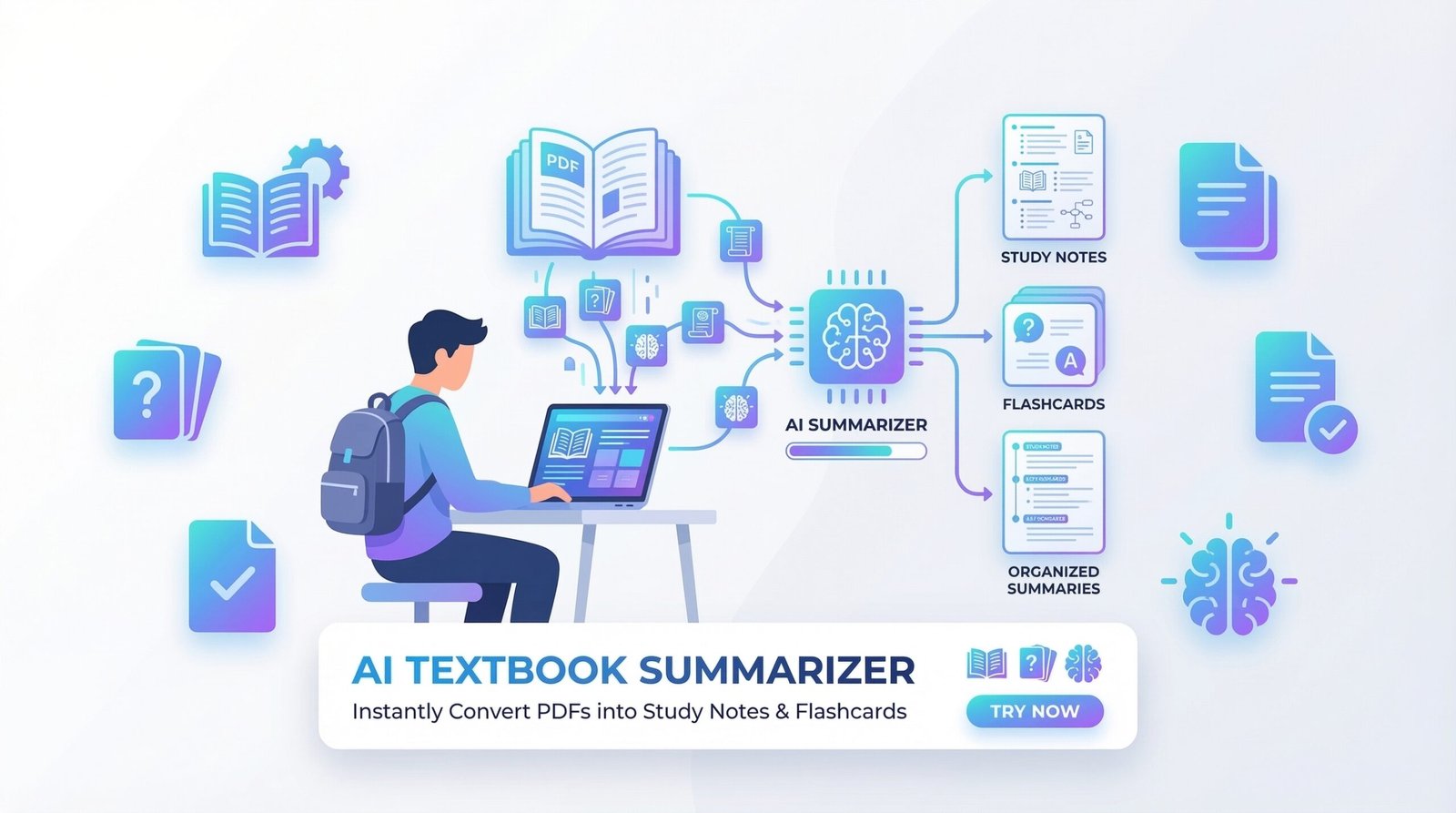
How AI Tools for Summarizing Textbooks Work
Most AI textbook summarizers follow a simple process:
- Step 1: You upload a textbook chapter, reading, PDF, or lecture notes.
- Step 2: The AI scans the text and identifies headings, definitions, repeated ideas, and important concepts.
- Step 3: It condenses the material into a shorter format such as a summary, bullet notes, study guide, or quiz.
- Step 4: In more advanced tools, you can ask follow-up questions, request simpler explanations, or generate flashcards.
Some tools focus on quick summarization. Others work more like an AI textbook summarizer plus tutor, where you can keep asking questions until the topic makes sense.
Quick Comparison: Best AI Tools for Summarizing Textbooks
| Tool | Best For | Free Plan | Best Input | Best Output |
|---|---|---|---|---|
| NotebookLM | Deep study and multi-source learning | Yes | PDFs, notes, docs | Study guides, quizzes, flashcards |
| Mindgrasp AI | Student study workflows | Limited | PDFs, lectures, videos | Notes, summaries, quizzes |
| Knowt AI | Exam prep and memorization | Yes | PDFs, notes, slides | Flashcards, quizzes, practice tests |
| Scholarcy | Academic chapters and papers | Limited | PDF, Word, PPT, text | Flashcard-style summaries |
| SciSpace | Research-heavy textbooks | Limited | Academic PDFs | Section summaries, citation-backed answers |
| ChatPDF | Fast PDF Q&A | Yes | PDFs | Quick summaries and questions |
| NoteGPT | Fast book and PDF summarization | Limited | Books, PDFs | Summaries and mind maps |
| QuillBot Summarizer | Short text summaries | Yes | Text excerpts | Paragraph or bullet summary |
17 Best AI Tools for Summarizing Textbooks in 2026
1. NotebookLM
Best for: Deep understanding, multi-source study, and grounded summaries
NotebookLM is one of the strongest choices if you want more than a simple summary. It works best when you upload textbook chapters alongside your class notes, reading lists, or supporting PDFs and want one place to generate study guides, quizzes, and flashcards.
Best input: multiple PDFs, notes, and source documents
Best output: study guides, quizzes, flashcards, grounded answers
Who should use it: students who want deeper understanding, not just shorter text
Who should skip it: students who only want a quick one-click summary and nothing else
Where it is weaker: if your goal is pure memorization, Knowt may feel more exam-focused
You can explore the tool here: NotebookLM.
2. Mindgrasp AI
Best for: Students who want summaries, notes, flashcards, and quizzes in one workflow
Mindgrasp AI is built more directly around studying than some general-purpose tools. It works well for textbook chapters, lecture slides, uploaded PDFs, and even recorded material, making it a strong fit for students who want one tool to handle several study tasks quickly.
Best input: PDFs, lectures, slides, study materials
Best output: structured notes, summaries, quizzes, flashcards
Who should use it: students who want speed and convenience
Who should skip it: researchers who need deeper citation-level academic analysis
Where it is weaker: for research-heavy papers, SciSpace or Scholarcy may be a better fit
Visit the official website to try it: Mindgrasp AI.
3. Knowt AI
Best for: Turning textbook PDFs into flashcards, quizzes, and practice tests
Knowt is one of the best choices if your real goal is not just summarization but memorization. It is especially useful when you want to upload a PDF and move quickly into active recall, flashcards, and test-style practice.
Best input: PDFs, notes, slides
Best output: flashcards, quizzes, study guides, practice questions
Who should use it: students preparing for exams and revision-heavy subjects
Who should skip it: users who want the deepest long-form conceptual breakdowns
Where it is weaker: NotebookLM is usually better for deeper understanding across multiple sources
4. Scholarcy
Best for: Academic chapters, research papers, and structured key-point extraction
Scholarcy is a strong academic option because it turns imported files into summary flashcards and pulls out key claims, references, and concepts. It works especially well when textbook chapters feel closer to journal-style reading than general classroom notes.
Best input: PDF, Word, PowerPoint, text
Best output: summary flashcards, key claims, structured academic summaries
Who should use it: students in research-heavy subjects
Who should skip it: users who want a simple beginner-friendly interface for fast casual summaries
Where it is weaker: for quick mainstream study workflows, Mindgrasp or Knowt may feel easier
Learn more on the official website: Scholarcy.
5. SciSpace
Best for: Science, medicine, and research-heavy academic PDFs
If you are revising biology, medicine, psychology, or other evidence-heavy subjects, SciSpace can be more useful than a general summarizer. It is better at working with academic PDFs and supports citation-linked answers and section-wise summaries, which is helpful when you need to verify details.
Best input: academic PDFs and research papers
Best output: citation-backed answers, summaries, concept explanations
Who should use it: students and researchers dealing with technical reading
Who should skip it: students who only want a basic summary of school chapters
Where it is weaker: Knowt is usually better for flashcards and exam-style memorization
You can explore the platform here: SciSpace.
6. ChatPDF
Best for: Quick PDF summaries and follow-up questions
ChatPDF is useful when you want to upload a chapter and immediately ask questions about it. It is a practical choice for quick revision, but it is usually less complete than a full study workflow tool.
7. NoteGPT
Best for: Fast summaries plus visual mind-map support
NoteGPT is a good option for students who like visual learning. It is more useful when you want a quick summary and a simple way to see how ideas connect.
8. QuillBot Summarizer
Best for: Short excerpts and quick text-only summaries
QuillBot is still useful when you want to shorten a passage or chapter section quickly. It is more limited than full PDF study tools, so it works best for smaller chunks of text.
Try the summarizer on the official website: QuillBot Summarizer.
9. Paperpal
Best for: Academic PDFs and source-linked research summaries
Paperpal is strongest when you want academic summaries tied closely to the source. It is a better match for research reading than for simple school-level summarization.
10. Notion AI
Best for: Summarizing and organizing content inside your workspace
If you already keep your notes, reading lists, or revision system in Notion, Notion AI may fit your workflow better than a standalone summarizer, even if it is not the strongest PDF-first tool.
11. Smallpdf AI
Best for: Fast, simple PDF summarization
Smallpdf AI is useful if you want a lightweight workflow and do not need a lot of advanced study features.
12. StudyFetch
Best for: Auto-generated study materials from class content
StudyFetch is a better fit when your main goal is turning content into revision assets like flashcards and quizzes rather than only reading a shorter summary.
13. Mapify AI
Best for: Visual learners who prefer mind maps
Mapify is most useful when a chapter feels easier to understand as relationships and branches instead of paragraphs.
14. Glasp
Best for: Highlighting, collecting, and summarizing reading material
Glasp works better as a reading companion and note-layer than as a dedicated textbook summarizer.
15. Paperguide AI
Best for: Extracting key insights from long academic reading
Paperguide is more useful for literature-style academic review than for casual chapter shortening.
16. LightPDF AI
Best for: Basic PDF interaction and simplification
LightPDF AI is a practical option when you want help understanding PDF content without a more advanced study platform.
17. ChatGPT
Best for: Flexible custom prompting and explanation
ChatGPT is useful when you want to control the output closely. It can summarize textbook chapters, explain difficult concepts, create test questions, or rewrite material at a simpler level, but the quality depends heavily on the prompt you use.
Best AI Tools for Summarizing Textbooks by Use Case
Best AI Tools for Students
- Mindgrasp AI – best all-in-one study workflow
- Knowt AI – best for revision and memorization
- NotebookLM – best for deeper understanding
Best AI Tools for Research Papers and Academic Chapters
- SciSpace – best for technical PDFs
- Scholarcy – best for structured academic extraction
- Paperpal – best for source-linked academic summaries
Best AI Tools for Flashcards
- Knowt AI – best overall for textbook-to-flashcard workflows
- StudyFetch – best for turning material into study assets
- Scholarcy – best for academic flashcard-style summaries
Best AI Tools for Summarizing PDF Textbooks
- NotebookLM – best overall for deeper PDF study
- ChatPDF – best for quick PDF Q&A
- SciSpace – best for academic and technical PDFs
- Knowt AI – best for PDF to flashcards and quizzes
Best AI Tools for Visual Learners
- Mapify AI – best for mind maps
- NoteGPT – best for quick visual support
Best AI Tools for Different Subjects
Best for Science Textbooks
SciSpace is usually the better choice for science-heavy material because it is stronger with academic PDFs and question-based exploration.
Best for Medical Textbooks
SciSpace and NotebookLM are strong picks if you need deeper explanation and source-grounded study support.
Best for Law, Theory, and Humanities
NotebookLM is useful when you want to combine textbook chapters with notes and extract arguments more clearly. Scholarcy can also help with structured breakdowns.
Best for Business and Management Textbooks
Mindgrasp AI is a good fit when you want cleaner notes, quick summaries, and quiz support without a research-heavy workflow.
Best AI Tools That Turn Textbooks Into Flashcards Automatically
If your real goal is to remember the material, not just shorten it, then you should focus on tools that double as an AI flashcard generator from PDF.
- Knowt AI – best for instant flashcards and practice tests from PDFs
- StudyFetch – best for broader revision assets
- Scholarcy – best for flashcard-style academic summaries
- Mindgrasp AI – strong for notes plus flashcards
This is especially important for exam revision. A plain summary helps with understanding, but flashcards and quizzes help with active recall.
Best AI Tools for Summarizing PDF Textbooks
If you are specifically searching for an AI PDF summarizer for students, these are the strongest choices:
- NotebookLM – best for deep PDF study and multi-source review
- Knowt AI – best for turning PDF chapters into flashcards and quizzes
- SciSpace – best for academic PDFs and technical subjects
- ChatPDF – best for fast summaries and follow-up questions
- Paperpal – best for academic PDF research workflows
If your textbook is scanned, technical, or research-heavy, prioritize tools with stronger PDF handling and question-based exploration.

Free vs Paid AI Tools for Summarizing Textbooks
Best Free AI Tools for Summarizing Textbooks
- NotebookLM – best free overall choice for deeper study
- QuillBot Summarizer – good for quick text summaries
- ChatPDF – useful for lighter PDF use
- Knowt AI – strong free option for study-focused outputs
Best Paid AI Study Tools
- Mindgrasp AI – best all-in-one student workflow
- SciSpace – best for academic and technical content
- Scholarcy – best for structured research-style reading
- NoteGPT – useful for larger visual study workflows
Free tools are often enough for quick summaries. Paid tools become more useful when you need larger uploads, better PDF handling, more automation, or more advanced study outputs.
How to Choose the Best AI Tool for Summarizing Textbooks
Choose by file type
If most of your reading is in PDF format, pick a stronger AI PDF summarizer like NotebookLM, Knowt, SciSpace, or ChatPDF.
Choose by study goal
If you need deeper understanding, NotebookLM is stronger. If you need flashcards and exam prep, Knowt or StudyFetch is often better.
Choose by subject
For science and medical reading, SciSpace is often more useful. For theory-heavy reading, NotebookLM or Scholarcy may be better.
Choose by output
If you want notes, choose Mindgrasp. If you want flashcards, choose Knowt. If you want citation-backed academic answers, choose SciSpace or Paperpal.
Choose by workflow fit
If you already organize your study system in Notion, Notion AI may fit your routine better even if another tool is stronger on paper.
Best Alternatives If One Tool Feels Too Limited
- If NotebookLM feels too research-focused, try Mindgrasp AI.
- If QuillBot feels too basic, try ChatPDF or Knowt AI.
- If ChatPDF feels too light, try SciSpace.
- If SciSpace feels too academic, try NotebookLM or Mindgrasp.
- If Notion AI feels too workspace-dependent, use a dedicated PDF-first tool instead.
Limitations of AI Textbook Summarizers
AI tools can save time, but they still have limits.
- Missing context: summaries can remove useful detail
- Oversimplification: some nuanced arguments become too simple
- Formula weakness: highly technical tables and equations may not be handled well
- Hallucinations: some explanations may still be inaccurate
- Over-reliance: reading only summaries can weaken real understanding
The best approach is to use AI as a study assistant, not a replacement for the original material.
How to Write Better Prompts for AI Textbook Summaries
A better prompt usually gives a better result. Instead of asking for “a summary,” ask for a specific study output.
Prompt for a study guide
Summarize this textbook chapter like a study guide.
Include key concepts, important definitions, a bullet summary, and 5 revision questions.
Keep it simple and student friendly.
Prompt for flashcards
Read this chapter and turn it into 15 flashcards.
Focus on definitions, cause-effect relationships, and exam-relevant facts.
Prompt for exam prep
Summarize this chapter for exam revision.
List the most important points first, then create 10 likely exam questions with short answers.
Prompt for beginners
Explain this textbook chapter as if I am new to the subject.
Use simple language, short examples, and avoid jargon where possible.
Prompt for chapter comparison
Compare this chapter with the previous chapter.
Show what ideas repeat, what is new, and what is most important to revise first.
How AI Tools for Summarizing Textbooks Help Students Study Faster
One of the biggest advantages of using AI tools for summarizing textbooks is that they help students study more efficiently. Instead of spending hours reading long chapters, students can quickly extract the most important concepts and focus on understanding the material.
Modern AI textbook summarizers analyze long textbook chapters, research papers, and PDF documents to identify key points, definitions, and important explanations. This allows students to review complex topics much faster.
Many students now use AI study tools to:
- summarize textbook chapters automatically
- convert PDFs into structured study notes
- generate flashcards for exam preparation
- create quizzes to test their knowledge
- simplify difficult academic explanations
For example, a student studying biology could upload a 30-page textbook chapter and instantly receive a short summary with key terms and concepts. This makes revision easier and helps students focus on the most important information before exams.
When used correctly, the best AI tools for summarizing textbooks can save time, improve comprehension, and make studying more productive.
Best AI Workflow for Studying With AI
A strong workflow usually works better than using just one tool.
Step 1: Upload the textbook chapter
Use NotebookLM or Mindgrasp AI for the first-pass summary.
Step 2: Extract the important study points
Use Scholarcy or SciSpace if the chapter is technical or research-heavy.
Step 3: Turn it into revision material
Use Knowt AI or StudyFetch to create flashcards, quizzes, and review sets.
Step 4: Test yourself
Do not stop at the summary. Use flashcards and quiz questions to check what you actually remember.
Step 5: Ask for simpler explanations
If a section still feels confusing, ask ChatGPT, NotebookLM, or SciSpace to explain it in beginner-friendly language.
Step-by-Step Guide to Summarizing a Textbook With AI
Step 1: Pick the right tool
Choose the tool based on your file type and study goal.
Step 2: Upload the chapter
Use a PDF, reading handout, or notes file.
Step 3: Use a stronger prompt
Summarize this textbook chapter as a study guide.

Include:
1. Key concepts
2. Important definitions
3. Bullet-point notes
4. Real-world examples
5. 10 flashcards
6. 5 exam questions

Keep the explanation simple and student friendly.
Step 4: Review the output
Check whether the summary missed anything important.
Step 5: Convert it into revision assets
Turn the output into flashcards, quiz questions, or a one-page review sheet.
Tips for Using AI Study Tools Effectively
- Use AI for first-pass compression, not final understanding
- Ask for examples if a concept still feels abstract
- Turn notes into questions, not just shorter notes
- Review your flashcards over multiple sessions
- Double-check important facts, formulas, and definitions
Common Mistakes Students Make
Using only summaries
A summary helps, but it cannot replace understanding a difficult chapter fully.
Choosing the wrong tool
A text summarizer is not always enough for a technical PDF or exam-heavy subject.
Using weak prompts
Generic prompts usually produce generic outputs.
Skipping verification
Always check important details against the original chapter.
Why AI Tools for Summarizing Textbooks Are Becoming Essential for Students
Students today deal with a huge amount of reading, especially in subjects that rely on large textbooks, research papers, and academic PDFs. Reading every page carefully can take hours, which makes revision difficult when exams or assignments are approaching.
This is where AI tools for summarizing textbooks are becoming extremely useful. These tools help students extract the most important ideas from long chapters without losing the overall meaning of the material.
Instead of manually highlighting every section, AI tools for summarizing textbooks can quickly identify key concepts, definitions, examples, and conclusions from a chapter. The result is a shorter and clearer version of the content that is easier to review later.
Many modern AI tools for summarizing textbooks also go beyond simple summaries. They can automatically generate flashcards, quizzes, study guides, and even simplified explanations for complex topics.
For students who need to review multiple chapters quickly, using AI tools for summarizing textbooks can save significant time and make the learning process more efficient.
Frequently Asked Questions
What is the best AI tool for summarizing textbooks?
NotebookLM is one of the best AI tools for summarizing textbooks because it supports PDFs, creates study guides, answers questions from uploaded material, and helps students understand topics more deeply. Mindgrasp, Knowt, and Scholarcy are also strong options depending on study style.
Can AI turn textbooks into flashcards?
Yes. Tools like Knowt AI, Mindgrasp AI, StudyFetch, and Scholarcy can turn textbook chapters, notes, or PDFs into flashcards, quizzes, and revision sets. These tools are especially useful for exam prep because they support active recall instead of passive reading.
Which AI tool is best for PDF textbooks?
NotebookLM, Knowt AI, SciSpace, ChatPDF, and Paperpal are some of the best tools for summarizing PDF textbooks. The best choice depends on whether you want deep explanation, quick summaries, or flashcards and quizzes.
What is the best AI textbook summarizer for students?
Mindgrasp AI and Knowt AI are strong choices for students because they focus on practical study outputs like notes, flashcards, quizzes, and revision support. NotebookLM is stronger when you want deeper understanding across multiple materials.
Are free AI tools for summarizing textbooks good enough?
Yes, for many students they are. Free tools are often good enough for quick summaries and basic study support. Paid tools become more valuable when you need better PDF handling, larger uploads, deeper academic features, or more automation.
Final Thoughts
AI tools for summarizing textbooks are now good enough to save students real time, especially when the goal is to turn long chapters into something usable for revision.
If you want the best all-around option, NotebookLM is one of the strongest choices. If you want a faster student workflow, Mindgrasp AI is a smart pick. If your goal is memorization, Knowt AI may help more than a tool focused only on paragraph summaries. If your reading is technical or research-heavy, SciSpace and Scholarcy are stronger options.
The best result usually comes from combining tools: one for summarizing, one for structure, and one for flashcards or quizzes.
Used well, these tools can help you study faster, revise smarter, and get more value from every textbook chapter you read.